
On this page
- When should gutters be replaced?
- What does a gutter replacement involve?
- How does replacement work with a hail claim?
- What should I upgrade while the gutters are off?
- Why does the old system so often turn out too small?
- Which material should replace the old one?
- What should I check on the day?
- What it costs
When should gutters be replaced?
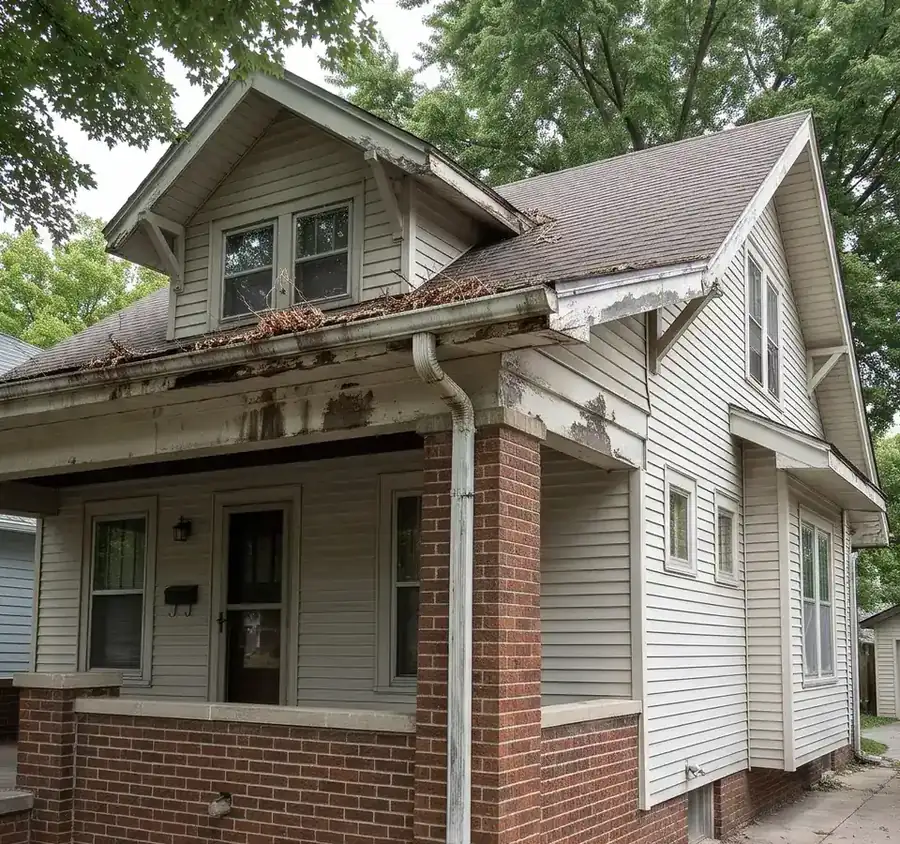
Gutters should be replaced when the faults are spread along the system instead of sitting at one joint or one hanger. Langford & Sons Gutters connects callers with independent local gutter contractors, who give the estimates and do the work, and a contractor weighing repair against replacement looks for these signs:
| Sign | What it means | Repair or replace |
|---|---|---|
| Hail dents and creases on every side | Metal is deformed; pitch may be lost | Replace, often through insurance |
| Leaks at many seams | Sectional gutter at the end of its life | Replace with seamless |
| Sagging along several eaves | Spikes loose; fascia may be soft | Replace and check the wood |
| Standing water after rain | Pitch gone or runs bent | Replace or fully re-hang |
| Overflow when clean | Gutter too small for the roof | Replace with a larger size |
| Peeling paint or rust | Coating failed | Replace |
| A single leaking corner | One joint | Repair |
What does a gutter replacement involve?
- Inspection and measurement. Every eave is measured and the roof above it assessed.
- Documentation. If a claim is involved, damage is photographed before removal.
- Removal. Old gutter, spikes and downspouts come down. Spike holes in the fascia are filled or covered.
- Fascia and drip edge. Soft boards are replaced and primed. Drip edge is added if the roof has none.
- New gutter. Seamless runs are formed on site, pitched and hung on hidden hangers.
- Downspouts and discharge. New downspouts go on, with extensions or drain lines.
- Test and haul away. Water is run through and the old metal goes for recycling.
How does replacement work with a hail claim?
After a damaging storm, the adjuster's report usually lists gutters, downspouts and guards by the foot alongside the roof. Three points keep the process clean:
- You pay your deductible. The Texas Department of Insurance states that it is illegal for a contractor to waive or rebate it, and that a contract of $1,000 or more tied to an insurance settlement must say so.
- Sequence matters. Gutters go on after the roof, so the drip edge and shingle edge are finished first.
- Like for like is the baseline. The claim pays to restore what was there. Moving from 5-inch to 6-inch, or adding guards, is usually an upgrade you pay for.
The page on hail and storm damage has more.
What should I upgrade while the gutters are off?
| Upgrade | Why it helps in Plano | More |
|---|---|---|
| 6-inch gutter | More capacity below valleys in thunderstorm rain | 6-inch gutters |
| 0.032-inch aluminum | Stiffer; marks less in small hail | Aluminum gutters |
| 3x4 downspouts | Twice the cross-section of 2x3; clog less | Downspouts |
| Extra downspouts | Less water at any one corner of the slab | Clay soil and slabs |
| Hidden hangers at 2 feet | Hold through heat cycles and storms | Sagging gutters |
| Micro-mesh guards | Stops live oak debris | Gutter guards |
| Buried drain lines | Carries water to the curb, off the clay | Downspout drainage |
Why does the old system so often turn out too small?
Many houses were fitted with 5-inch gutter and 2x3 downspouts because that was the standard package, not because anyone measured the roof. A two-story house with a steep hip roof can send several hundred square feet of roof down a single valley onto a few feet of gutter. In a May thunderstorm that spot overflows no matter how clean the gutter is. Replacement is the chance to size each run for what actually drains to it.
Which material should replace the old one?
Most replacements in Plano are seamless aluminum, in a heavier gauge if the old ones were lost to hail. Steel is stiffer and worth a quote. Copper suits custom homes where the gutter is part of the look. The guide to aluminum, steel and copper compares them, and seamless versus sectional explains why the joints matter.
What should I check on the day?
- The coil color against the trim before any gutter is formed.
- That soft fascia found during removal is shown to you and priced before it is covered.
- Outlet positions, especially below valleys.
- That every downspout has its extension or drain connection.
- A hose test on each run before the crew leaves.
What it costs
Published national guides put replacement at about $9 to $14 a foot for 5-inch seamless aluminum and $11 to $17 for 6-inch, installed. Removal of the old system, fascia repair, second-story eaves and guards add to that. These are national ranges, not Plano quotes. See the cost guide.
Ballpark for your roofline
$1,440 to $2,240
Arithmetic from national price ranges (Angi aluminum gutter cost guide, This Old House seamless gutter cost guide), not a local quote. The number of corners and downspouts, fascia repairs and awkward access all move it. A contractor who has measured your house gives the real figure.