
On this page
Why is aluminum the standard gutter metal?
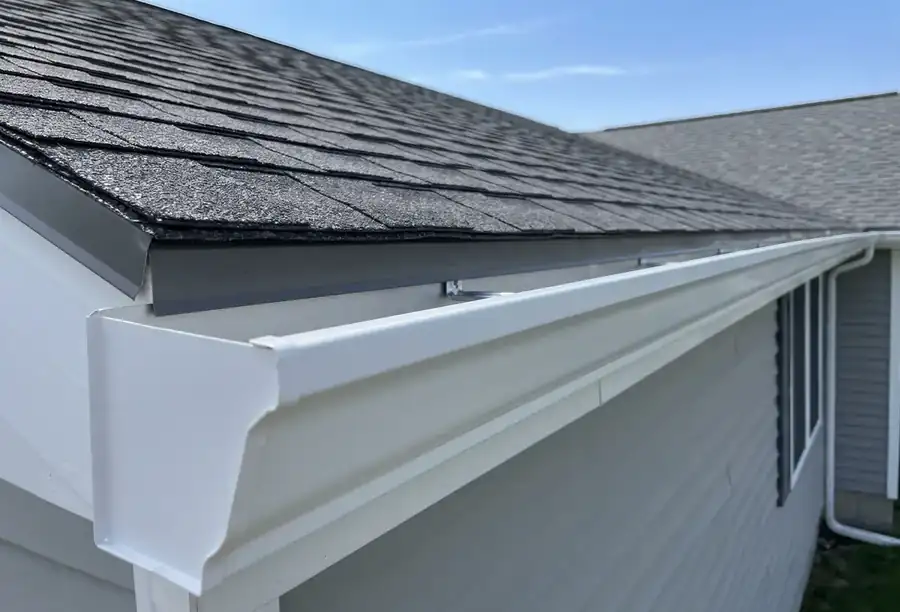
Aluminum is the standard because it does not rust, it is light enough to form and lift in long seamless lengths, it comes pre-painted, and it costs less than steel or copper. Langford & Sons Gutters connects callers with independent local gutter contractors, who give the estimates and do the work, and aluminum is what they fit on most houses.
Which gauge should I choose?
| Gauge | Thickness | Character | Suits |
|---|---|---|---|
| 0.027 inch | Standard residential | Lighter; dents more easily | Budget jobs; sheltered one-story runs |
| 0.032 inch | Heavy residential | Stiffer; resists small hail and ladders | Most Plano houses; long runs; 6-inch gutter |
Some national builders' gutters are thinner still. If your existing gutters dent under thumb pressure, they are light gauge. Ask the contractor to write the gauge on the quote.
Where does aluminum fall short?
- Large hail. No aluminum gutter resists golf-ball hail. See hail and gutters in North Texas.
- Expansion. Aluminum moves more with temperature than steel, which works the joint sealant.
- Contact with copper or runoff from it causes corrosion.
- Strength. A ladder leaned on the front lip can crease it. Use a standoff.
Which colors and profiles are available?
Coil is stocked in a wide range of factory colors: whites and creams, clay and tan shades that sit well against Texas brick, bronzes, browns, grays and black. Most suppliers publish a chart, and a contractor can bring samples to hold against your trim. HOA communities often name an approved color. Profiles are K-style in 5 and 6 inch and half-round in 5 and 6 inch.
| Finish | Looks best on | Note |
|---|---|---|
| White or cream | Painted trim, light brick | Shows dirt streaks; chalks least visibly |
| Clay, tan, almond | Blended and buff brick | The usual match for Plano brick homes |
| Dark bronze or brown | Red and brown brick, stone | Hides stains; shows chalking over time |
| Black or charcoal | Modern and painted-brick houses | Hottest surface; moves most in sun |
How does aluminum cope with local weather?
Heat. Summer afternoons and cool nights make a long gutter lengthen and shorten daily. Hidden hangers that let the gutter slide a little, and good sealant at the corners, absorb it.
Hail. The March 2016 storm that the Insurance Council of Texas said hit Plano among the hardest is the kind of storm no gutter metal comes through unmarked. Heavier gauge reduces marking from the pea-to-quarter-size hail that is far more common than the big storms.
Freezes. Hard freezes are occasional. The record of February 2021, when Dallas-Fort Worth reached 2 below zero, showed that a gutter full of water or ice puts real weight on its hangers.
How are aluminum gutters installed?
- Choose coil by gauge and color.
- Form each run on site to length.
- Fit end caps and outlets, sealed and riveted.
- Hang on hidden hangers every 2 feet with coated screws into solid fascia.
- Miter and seal corners.
- Fit aluminum downspouts with matching straps.
- Water-test.
What should be written on an aluminum gutter quote?
- Gauge: 0.027 or 0.032 inch
- Size and profile: 5 or 6 inch, K-style or half-round
- Color name from the coil chart
- Hanger type and spacing
- Downspout size and count
- Sealant and fastener type
What affects the price
Feet of gutter, 5 or 6 inch, gauge, stories, corners and downspouts set the base price. National guides give $9 to $14 a foot for 5-inch and $11 to $17 for 6-inch seamless aluminum, installed. Fascia work and guards are additional. See the cost guide.
Ballpark for your roofline
$1,440 to $2,240
Arithmetic from national price ranges (Angi aluminum gutter cost guide, This Old House seamless gutter cost guide), not a local quote. The number of corners and downspouts, fascia repairs and awkward access all move it. A contractor who has measured your house gives the real figure.