
On this page
- The short answer
- How do they compare?
- Why do joints matter in this climate?
- How many joints are involved?
- What are the parts of each system?
- When is sectional sensible?
- What does it cost over time?
- How does each cope with hail and heat?
- What should I look for in a seamless installation?
- Is seamless right for every Plano house?
- The bottom line
The short answer
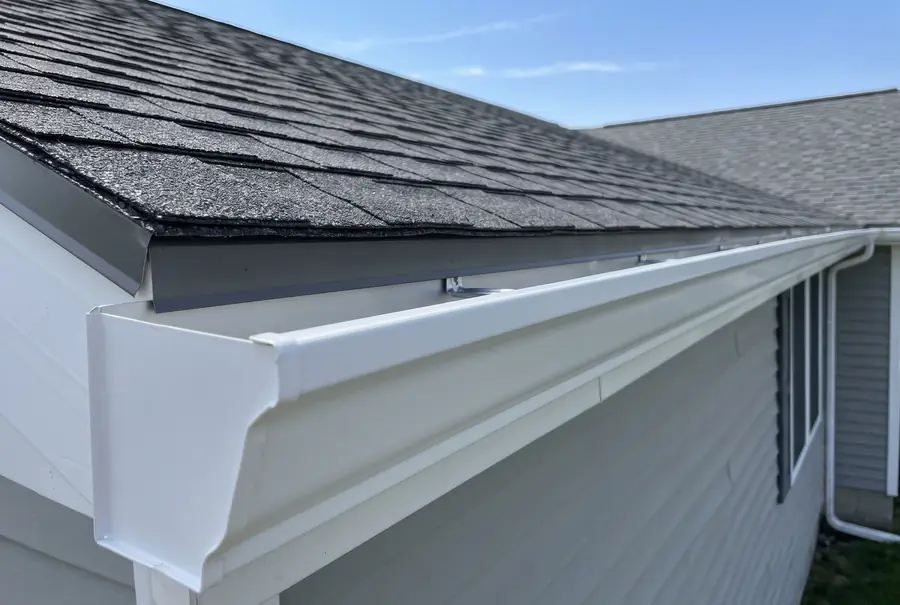
Choose seamless. For the same metal it has a fraction of the joints, and joints are where gutters leak, especially in a climate that bakes sealant. Sectional gutter makes sense only for short runs, sheds and repairs you intend to do yourself. Langford & Sons Gutters connects callers with independent local gutter contractors, who give the estimates and do the work, and seamless is what they install.
How do they compare?
| Feature | Seamless | Sectional |
|---|---|---|
| Made | On site, to length | Factory, 10-foot pieces |
| Joints on a 40-foot run | None along the run | Three connectors |
| Materials | Aluminum, steel, copper | Aluminum, vinyl, steel |
| Metal thickness | 0.027 or 0.032 inch | Often thinner |
| Fitted by | Contractor | Owner or handyman |
| Leak risk | Low; corners and ends only | Higher; every seam |
| Appearance | One clean line | Visible joints |
| Colors | Dozens | A few |
Why do joints matter in this climate?
A seam is two pieces of metal held by a connector and a bead of sealant or a rubber gasket. In Plano that seal faces strong sun, afternoon heat above 100 degrees in summer, cool nights, and rain that tends to arrive hard. The metal lengthens and shortens with temperature each day, and the seal has to stretch with it. After several summers it cracks. With about 39 inches of rain a year at Dallas Love Field falling in relatively few heavy events, a cracked seam shows itself quickly.
How many joints are involved?
| House | Eave length | Sectional seams along runs | Seamless seams along runs |
|---|---|---|---|
| Patio home | 100 ft | About 8 | 0 |
| One-story ranch | 180 ft | About 14 | 0 |
| Two-story hip roof | 240 ft | About 16, plus corners | 0 |
Both systems also have corners, end caps and outlets. Those are the only joints a seamless system has.
What are the parts of each system?
- Seamless: continuous trough, end caps, miters, outlets, hidden hangers.
- Sectional: 10-foot troughs, slip connectors, end caps, corner pieces, drop outlets, hangers or spikes.
Every sectional part is a separate piece joined to the next, and each joint is another seal to fail.
When is sectional sensible?
- A short run over a door or on a shed.
- A do-it-yourself job on a single-story outbuilding.
- A temporary fix until a full replacement.
- A single damaged piece in an otherwise sound sectional run.
What does it cost over time?
Sectional gutter is cheaper to buy and dearer to keep. Each seam will want resealing every few years, thin sections dent and sag, and spike fixings loosen. Seamless costs more on the day and less afterward. National guides put seamless aluminum at about $9 to $17 a foot installed; see the cost guide.
- Count the seams you have now.
- Note how many leak or have been patched.
- Ask a contractor what resealing all of them would cost.
- Compare that with the price of new seamless runs.
How does each cope with hail and heat?
| Condition | Seamless | Sectional |
|---|---|---|
| Daily heat movement | Taken up at corners and by sliding in the hangers | Works every seam along the run |
| Hail on thin metal | Dents less in 0.032 gauge | Store sections are often thinner and dent more |
| Hail on joints | Few joints to break | Connectors crack or spring |
| Wind | Continuous length resists lifting | Sections can separate at seams |
| Insurance replacement | Priced by the foot for the run | Usually replaced with seamless anyway |
What should I look for in a seamless installation?
- One length per straight eave, with no mid-run splice.
- Gauge stated on the quote.
- Hidden hangers at 2-foot centers, screwed, not nailed.
- Corners riveted and sealed inside, with no sealant smeared on the outside.
- Outlets at low points and near valleys.
- A water test before the crew leaves.
Is seamless right for every Plano house?
For nearly all of them. Tract ranches, two-story brick homes, patio homes and custom houses are all straightforward for a forming machine. The alley-and-driveway layout of most Plano subdivisions makes access easy. The exceptions are curved eaves and small outbuildings, where short sections are practical.
The bottom line
If your gutters leak at regular intervals along the eave, they are sectional and near the end of their useful life. Seamless replacement removes those joints for good. See seamless gutters for what to specify.