
On this page
What makes a downspout layout work?
A downspout layout works when every part of the gutter has a short route to an outlet, every outlet can carry its share of the roof in a storm, and every downspout empties somewhere harmless. Langford & Sons Gutters connects callers with independent local gutter contractors, who give the estimates and do the work. Three decisions are involved: how many, how big and where to.
What are the parts of a downspout?
| Part | What it does |
|---|---|
| Outlet (drop) | Opening in the gutter floor that feeds the downspout |
| Upper elbows | Two bends that bring the pipe back to the wall under the eave |
| Downspout | The vertical pipe, 2x3 or 3x4 inch, or round |
| Straps or brackets | Fix the pipe to brick or siding |
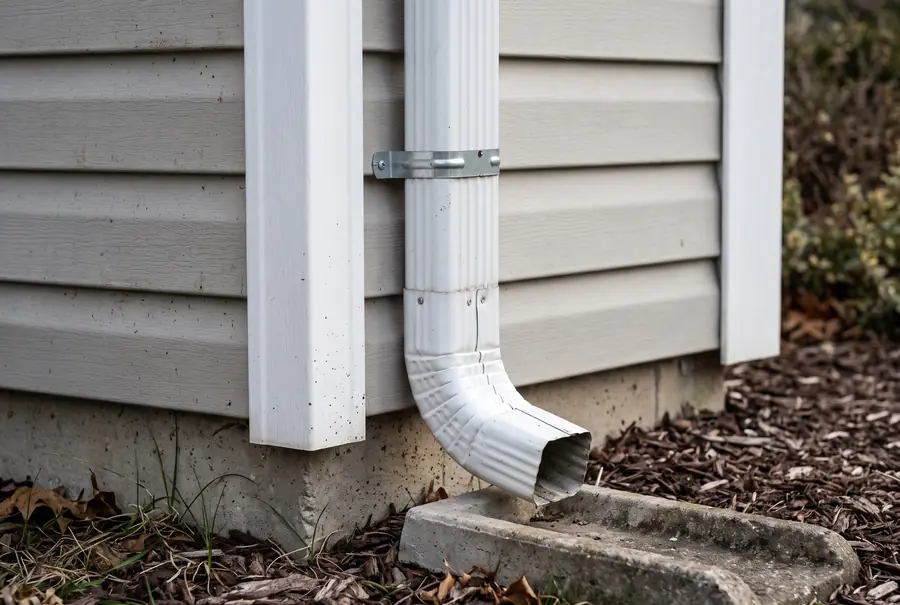
| Lower elbow (shoe) | Turns the water outward at the bottom |
| Extension | Carries water out past the beds |
| Splash block | Spreads the flow and stops erosion |
| Drain adapter | Connects to a buried line |
| Pop-up emitter | Lidded outlet at the far end of a buried line |
How do 2x3 and 3x4 compare?
| Feature | 2x3 inch | 3x4 inch |
|---|---|---|
| Cross-section | 6 square inches | 12 square inches |
| Usually paired with | 5-inch gutter | 6-inch gutter, or 5-inch at valleys |
| Blockage | Elbows clog with leaves and pecan husks | Passes most debris |
| Appearance | Slimmer | More visible; can be placed at corners |
| Cost | Lower | A little higher per foot |
Why do outlets matter so much here?
Plano's rain arrives in bursts, and Plano's roofs gather it at valleys. Put those together and the limit on most systems is not the trough but the hole at the end of it. A single 2x3 outlet at the far end of a run that takes a valley will back up in a spring thunderstorm even if the gutter is spotless. The cures are simple: move or add an outlet near the valley, use a wide-mouth 3x4 outlet, and keep the top of the downspout clear.
Where should the water go?
On clay soil, this is the heart of the matter. The USDA rates the Blackland Prairie's Houston Black clay as very slowly permeable with high shrink-swell potential. Water released at the wall does not soak in; it sits, and the clay beneath that corner swells. The Geo-Institute's guide to living with shrink-swell soils advises a slope away from every side of the foundation, with gutters and downspouts to manage roof water.
| Discharge option | How it works | Suits | Watch for |
|---|---|---|---|
| Splash block | Spreads flow at the base | Ground that slopes well away | Too close to the slab on flat lots |
| Hinged or fixed extension | Carries water 3 to 6 feet out | Most houses | Trip hazard; mower damage |
| Buried solid pipe to pop-up | Releases water in the lawn | Flat lots, front beds | Needs fall; keep the emitter clear |
| Buried pipe to curb or alley | Sends water to the street drain | Lots graded to the street | Check local rules before cutting a curb |
| Rain barrel with overflow | Stores some, passes the rest | Garden watering | Overflow must still drain away |
The guides on downspout drainage and clay soil and slab foundations cover the reasoning.
How are downspouts installed?
- Place the outlets at low points, near valleys and at corners where the pipe can reach the ground.
- Cut and fit each outlet, riveted and sealed.
- Build the offset with two elbows so the pipe sits against the wall.
- Strap the pipe at the top, bottom and every 6 to 10 feet, with masonry anchors in brick.
- Fit the shoe and the discharge: extension, splash block or drain adapter.
- Run water and watch where it goes.
What affects the price
Downspouts are priced by length, size and number of elbows, with extra for second-story drops and for fixing to brick. Extensions are inexpensive. Buried drain lines are a larger job priced by the foot of trench, the number of connections and the outlet type. Ask for the discharge work to be itemized so quotes can be compared.