
On this page
The short answer
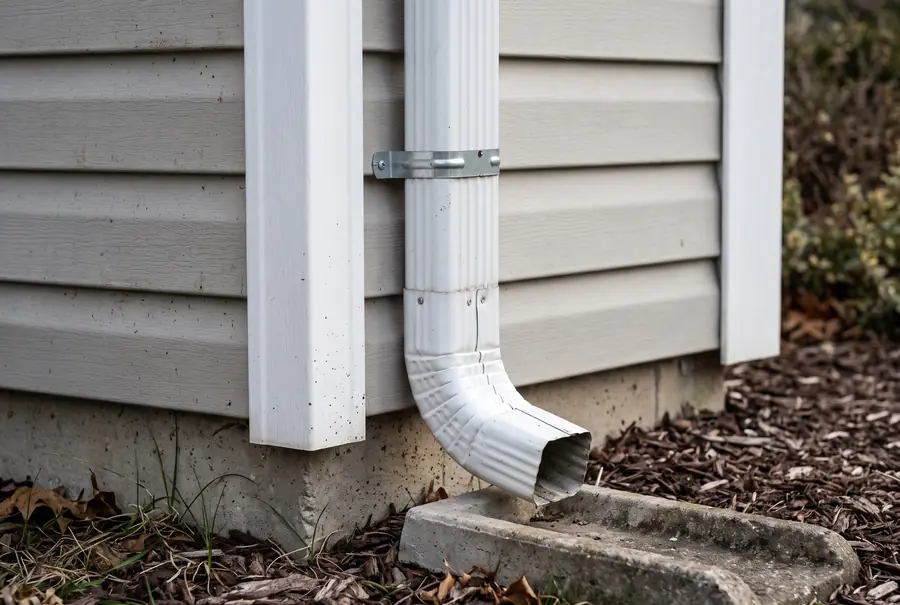
Every downspout should release its water where it will flow away from the slab: on sloping ground several feet out, or through a buried solid pipe to a pop-up emitter, the curb or the alley. Langford & Sons Gutters connects callers with independent local gutter contractors, who give the estimates and do the work.
Why does it matter so much here?
Plano's soil is Blackland Prairie clay, which the USDA describes as very slowly permeable with high shrink-swell potential. Water does not soak away quickly. Released at the wall, it ponds, follows shrinkage cracks down beside the slab and wets the clay unevenly. The guide to clay soil and slab foundations explains the mechanism.
How much water comes out of one downspout?
Using the Texas Water Development Board's figure of about 0.62 gallons per square foot of roof per inch of rain:
| Roof area on one downspout | Half-inch shower | One-inch storm | Two-inch storm |
|---|---|---|---|
| 300 sq ft | About 93 gallons | About 186 gallons | About 372 gallons |
| 500 sq ft | About 155 gallons | About 310 gallons | About 620 gallons |
| 800 sq ft | About 248 gallons | About 496 gallons | About 992 gallons |
A valley downspout on a two-story house can easily carry the larger figures. That is several bathtubs of water at one corner in an afternoon.
What are the options?
| Option | Cost level | Upkeep | Best where |
|---|---|---|---|
| Splash block | Lowest | None | Ground slopes away already |
| Fixed extension | Low | Keep attached | Lawn beyond the bed |
| Hinged extension | Low | Flip down after mowing | Narrow side yards |
| Roll-out sleeve | Low | Replace when torn | Temporary use |
| Buried solid pipe to pop-up | Medium | Clear the emitter; flush yearly | Flat front yards |
| Buried pipe to curb | Medium to high | Flush as needed | Lots that fall to the street |
| Dry creek or swale | Medium | Keep clear | Larger lots |
How is a buried downspout line built?
- Plan the route from the downspout to a point lower than the house.
- Call 811 to have utilities marked before digging.
- Trench with steady fall away from the house.
- Lay solid smooth-wall pipe; corrugated pipe holds silt.
- Fit an adapter and clean-out at the downspout.
- Set the emitter or curb outlet at the end.
- Backfill and test with a hose.
Sprinkler lines are everywhere in Plano front yards, so expect the contractor to locate or repair irrigation along the route.
What about tight side yards and zero-lot-line homes?
Many Plano patio homes and newer houses stand a few feet apart. A downspout on that side has little ground to work with. The usual answers are a buried line running to the front or back, a shared swale graded along the property line, or moving the downspout to a corner where there is room. Water must stay on your own lot or go to the street or alley.
What about grading and beds?
Drainage is not only pipes. Soil should fall away from the slab, and a few inches of slab should show above the soil and mulch. Raised beds, solid edging and added topsoil often reverse the slope over the years. A downspout extension that crosses the bed and clears the edging deals with roof water even where the bed itself is not ideal.
How do I check what I have?
- Count the downspouts and note where each one ends.
- Measure how far each outlet is from the slab.
- Pour a bucket of water at each outlet and watch which way it runs.
- Find the end of any buried line and confirm water comes out when a hose runs in.
- Look for erosion, standing water or soil pulled away from the slab.
- After heavy rain, check again.
What mistakes are common?
| Mistake | Result | Better |
|---|---|---|
| Corrugated flexible pipe underground | Silts up; crushes | Smooth-wall solid pipe |
| Emitter set in a low spot | Water sits in the line | Emitter at the lowest point, with fall |
| Line ending in a bed by the house | Water returns to the slab | Outlet in open lawn or at the curb |
| Two large downspouts on one small pipe | Backs up in storms | Size the pipe for both |
| Extension removed for mowing | Water at the wall | Hinged extension |
The bottom line
Decide where each downspout's water will go before the gutters are hung. On Plano clay, a few feet of extension or a buried line is the cheapest protection a slab can have. See downspouts and downspout repair.