
On this page
Why do gutters sag?
Gutters sag when their fixings loosen, when the wood behind them fails, or when they carry more weight than they were hung for. Langford & Sons Gutters connects callers with independent local gutter contractors, who give the estimates and do the work. The usual causes:
- Spikes and ferrules backing out after years of heat cycles
- Hangers spaced too far apart, often 3 feet or more
- Rotten fascia that no longer holds a screw
- Weight: wet leaves, standing water, or ice after a hard freeze
- Ladders leaned against the gutter lip
- Hail and falling limbs bending the run
What are the types of gutter hanger?
| Hanger | How it fixes | Strength | Notes |
|---|---|---|---|
| Spike and ferrule | Long nail through the gutter into the fascia | Weakest over time | Common on older Plano houses |
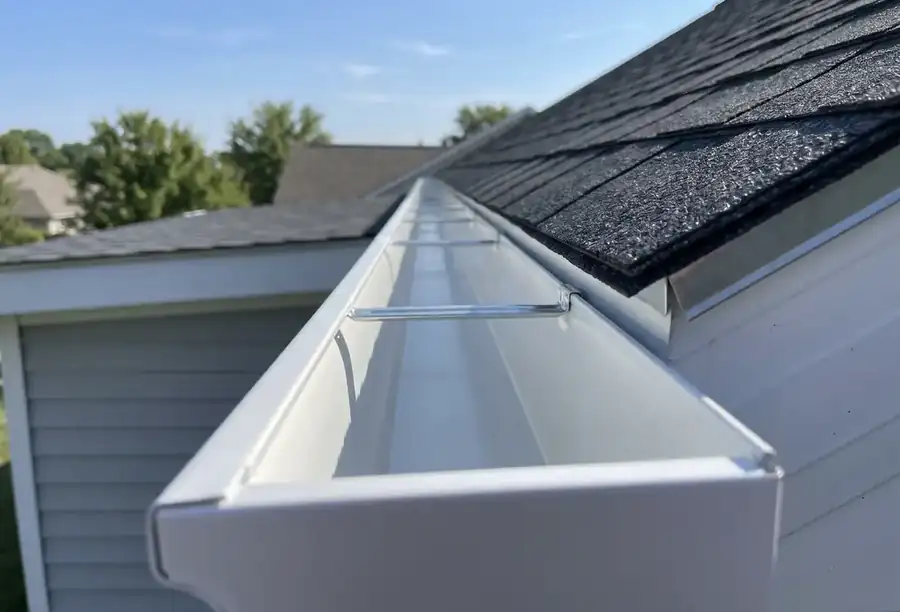
| Hidden hanger with screw | Clips inside the gutter; screw into fascia | Strong | Current standard |
| Hidden hanger with clip only | Nailed or clipped | Moderate | Builder-grade |
| Strap hanger | Strap fixed to the roof deck | Strong | For eaves with no fascia |
| Bracket | External bracket under the gutter | Strong | Half-round gutters |
How is a sagging gutter re-hung?
- Empty the gutter and check it for creases.
- Probe the fascia along the whole run.
- Snap a new pitch line from the high end to the outlet.
- Release the old fixings and lift the gutter to the line.
- Fit hidden screw-in hangers every 2 feet, closer near corners and below valleys.
- Pull or cut old spikes and seal the holes.
- Reseal corners and end caps disturbed by the movement.
- Run water and confirm it drains completely.
What pitch should a gutter have?
| Run length | Usual arrangement |
|---|---|
| Up to about 30 feet | Fall one way to a single outlet |
| 30 to 40 feet and more | High point in the middle, outlet at each end |
| Run with a valley partway | Outlet placed near the valley, fall toward it |
| Level-looking fascia on a formal front | Minimal fall, more outlets |
How do I tell a sag from a bigger problem?
- A dip between two fixings is a hanger problem.
- A whole run tilted forward suggests the fascia is rotating or rotten.
- A crease or kink means the metal is damaged and that section needs replacing.
- A gap between gutter and roof edge lets water run behind; the gutter may have been hung too low to begin with.
- Sagging on every side in a spike-hung system means all of it should be re-hung, or replaced if the gutter is also dented.
If the house has had foundation movement, eaves can go slightly out of level too. A contractor sets the gutter to a line, not to the fascia, for that reason.
How can I stop it happening again?
- Have gutters cleaned on schedule so they never carry a full load of wet debris. See gutter cleaning.
- Use ladder standoffs that rest on the roof.
- Replace spikes with screw-in hangers before they fail, not after.
- Ask for 0.032-inch aluminum when a run is replaced.
- Clear gutters ahead of a forecast freeze, so ice has nothing to form from.
What does a re-hang visit look like?
A contractor normally re-hangs one elevation at a time. The run is emptied, the old spikes or clips released, and the gutter propped while a chalk line is snapped. New hangers go in from the high end. Corners are resealed last, because lifting a run flexes its joints. On a one-story house, a full perimeter can usually be done in a few hours. The crew should show you any fascia they find soft before fixing to it.
| Symptom after a re-hang | What it means |
|---|---|
| Water still stands mid-run | Pitch needs another adjustment |
| Drip at a corner that was dry before | Joint flexed; needs resealing |
| Hanger screw spins | Fascia is soft at that point |
What affects the price
Re-hanging is priced by the length of run, the height and the number of hangers. Replacing fascia adds carpentry and paint. If the gutter itself is creased, a new seamless length for that run is added at the per-foot rate. One visit can usually deal with every run on the house.