
On this page
Where do gutters leak?
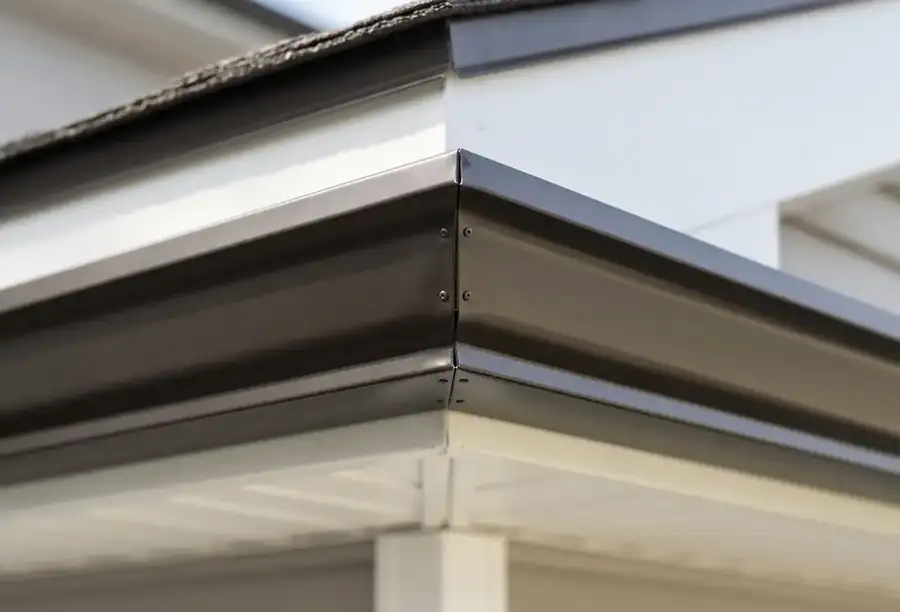
Gutters leak at their joints: corners, end caps, outlets and, on sectional gutter, the seam every 10 feet. Langford & Sons Gutters connects callers with independent local gutter contractors, who give the estimates and do the work. The table shows what each kind of leak looks like from the ground.
| Leak point | What you see | Cause |
|---|---|---|
| Inside or outside corner | Drip or stream below the corner | Sealant cracked; rivets loose |
| End cap | Drip at the very end of a run | Crimp opened |
| Outlet | Water down the outside of the downspout | Flange seal failed |
| Sectional seam | Drips at regular intervals | Connector seal aged |
| Behind the gutter | Stained fascia, drips from the soffit | No drip edge; gutter hung too low |
| Hole in the floor | Drip mid-run | Corrosion, a stray screw or hail |
Why do joints fail here?
Three local things work on gutter joints:
- Heat cycling. Aluminum expands in the afternoon and contracts at night. Over a North Texas summer that is more than a hundred cycles pulling at each bead of sealant.
- Ultraviolet light. Sun hardens most sealants until they lose their stretch.
- Full-bore flow. Rain here tends to come hard, so joints are tested under a full gutter, not a trickle.
Standing water makes it worse. A run that holds a puddle because it has sagged keeps its end cap and corner wet for days, and mosquitoes breed in it.
How is a leaking joint properly repaired?
- Run water to find the true source.
- Scrape and wire-brush the joint to bare, bright metal.
- Wipe with solvent and let it dry fully.
- Tighten the joint. Loose rivets are drilled out and replaced; a sprung miter is pulled together.
- Apply gutter sealant in a continuous bead on the inside, tooled into the seam.
- Let it cure, then test with a hose.
- Correct the cause if the run was holding water: re-hang or re-pitch.
Which repair suits which leak?
| Leak | Repair | Lasting fix when |
|---|---|---|
| Corner | Strip, re-rivet, reseal | Miter is straight and tight |
| End cap | Re-crimp or replace, seal | Run is not ponding |
| Outlet | New outlet, riveted and sealed | Outlet is at the low point |
| Sectional seams | Reseal each, or replace the run | Few seams; otherwise go seamless |
| Behind the gutter | Fit drip edge or gutter apron | Gutter back sits under the flashing |
| Hole | Patch plate in the same metal, sealed | Surrounding metal is sound |
When is a leak a sign of something bigger?
- Several joints leak at once. The sealant is at the end of its life throughout.
- The same joint keeps failing. The run is moving, sagging or holding water.
- Leaks appeared after hail. Check the whole system and the roof.
- The fascia is soft. Water has been getting behind for a long time. See fascia and soffit.
- The gutter is sectional. Seamless replacement removes most of the joints.
Can I fix a leak myself?
On a one-story eave, a careful owner can reseal a corner by following the steps above on a dry day. Use a sealant made for gutters, not general caulk. On a two-story house, or where the leak is over a steep bed or hard paving, the ladder work is the risk and it is better left to someone equipped for it.
Which sealant should be used?
| Product | Use on gutters? | Note |
|---|---|---|
| Gutter and flashing sealant (tripolymer or similar) | Yes | Stays flexible; bonds to aluminum |
| Polyurethane sealant | Yes | Durable; needs clean, dry metal |
| Silicone caulk | Poor | Peels from metal; nothing sticks to it later |
| Roofing tar | No | Cracks in heat; makes later repairs harder |
| Solder | Copper and steel only | The permanent joint for those metals |
What affects the price
A single corner or end cap on a one-story run is a small job. The price rises with height, the number of joints, and whether the run has to be re-hung or a section replaced. Most contractors have a minimum visit charge, so it makes sense to have every joint checked and a cleaning done in the same visit.