
On this page
Why choose copper gutters?
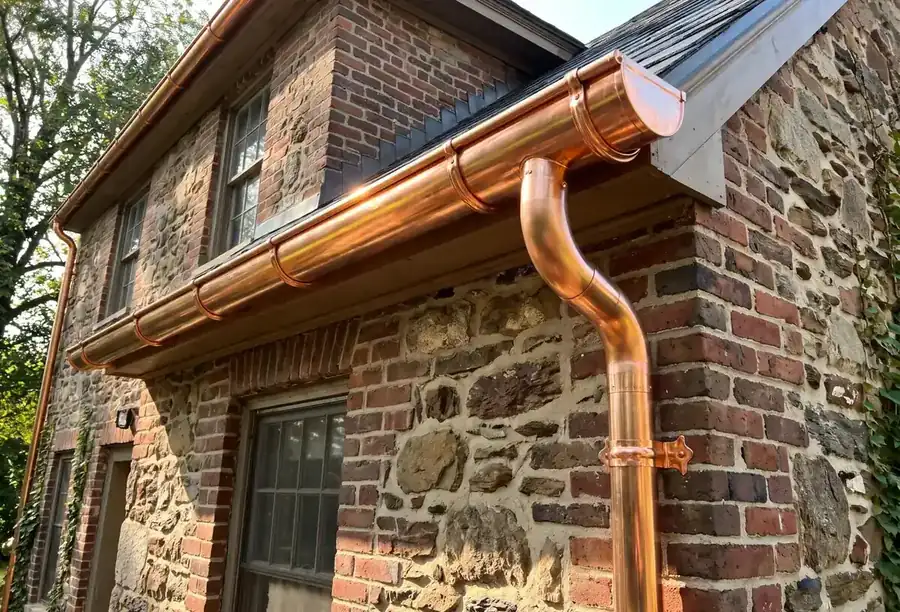
People choose copper gutters for a long service life, joints that are soldered solid, and a look that suits stone, brick and slate. Langford & Sons Gutters connects callers with independent local gutter contractors, who give the estimates and do the work. In the Plano area copper is mostly seen on custom homes in Willow Bend and West Plano, and on estate properties in Parker, Lucas and Fairview.
How does copper compare with other metals?
| Feature | Copper | Aluminum | Painted steel |
|---|---|---|---|
| Published national price, installed | $29 to $40 a foot | $9 to $17 a foot | $12 to $20 a foot |
| Joints | Soldered | Sealant and rivets | Sealant and rivets |
| Corrosion | Forms a protective patina | Does not rust | Rusts if coating is broken |
| Hail | Dents; heavier weights resist | Dents | Most resistant |
| Finish | Natural, changes with age | Factory paint, many colors | Factory paint |
| Upkeep | Cleaning only | Resealing joints over time | Touch-up of chips |
How does copper age in North Texas?
New copper is bright orange-pink. Within weeks it dulls, and through the first year or two it turns penny brown, then a deeper bronze. The blue-green layer people associate with old copper roofs forms slowest where the metal dries out quickly, and North Texas has long hot dry stretches. Expect brown for many years. Runoff from new copper can leave a faint stain on pale stone or concrete below a downspout, which is one more reason to carry the discharge away from the wall.
What should a copper specification include?
| Item | Typical choice | Notes |
|---|---|---|
| Weight | 16 oz or 20 oz per square foot | 20 oz is stiffer and takes hail better |
| Profile | Half-round or K-style | Half-round is the traditional pairing |
| Size | 6 inch | With 4-inch round or 3x4 downspouts |
| Joints | Lapped, riveted and soldered | No sealant-only joints |
| Hangers | Copper or brass brackets | Never plain steel |
| Fasteners | Copper, brass or stainless | Matches the metal's life |
| Expansion | Joints on long runs | Copper moves with heat |
What must not touch copper?
- Aluminum and bare steel. In contact with copper and water, they corrode. That includes aluminum drip edge and steel nails.
- Runoff onto other metals. Water that has crossed copper will attack an aluminum gutter or a galvanized surface below it.
- Some treated lumber. A separating layer is used where copper meets preservative-treated wood.
How does copper hold up to Texas heat and hail?
Heat makes copper expand, so long runs are built with expansion joints and free-floating brackets, and a soldered system has to allow for that movement or the seams crack. Hail is the more visible issue. The Insurance Council of Texas reported 4-inch hail north of Dallas in April 2016, and no gutter metal survives that unmarked. Copper costs far more to replace than aluminum, so ask your insurer how copper gutters are valued under your policy.
How are copper gutters installed?
- Set brackets to a line, at close spacing.
- Form the gutter from copper coil or cut from stock lengths.
- Lap and rivet each joint.
- Clean, flux and solder every seam, miter and outlet.
- Hang downspouts on copper or brass brackets.
- Rinse off flux and test with water.
Soldering is a sheet-metal skill that not every gutter crew has. Ask to see copper work the contractor has done.
What affects the price
The price of copper itself is the main factor and it moves with the commodity market. After that come weight, profile, the number of soldered joints, bracket style and height. National guides put installed copper at about $29 to $40 a foot. For how that compares, see aluminum vs steel vs copper.
Ballpark for your roofline
$1,440 to $2,240
Arithmetic from national price ranges (Angi aluminum gutter cost guide, This Old House seamless gutter cost guide), not a local quote. The number of corners and downspouts, fascia repairs and awkward access all move it. A contractor who has measured your house gives the real figure.