
On this page
How does a micro-mesh guard work?
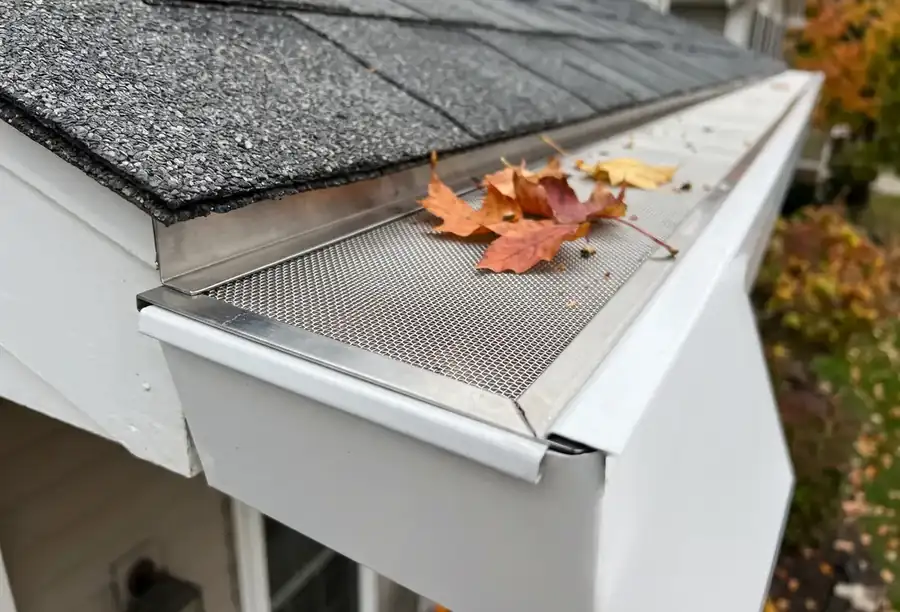
A micro-mesh guard is a fine woven stainless steel screen bonded to a rigid frame that covers the top of the gutter. Water passes through the mesh by surface tension and gravity; debris stays on top, dries and blows or washes off. Langford & Sons Gutters connects callers with independent local gutter contractors, who give the estimates and do the work.
Why is it the right guard for Plano's trees?
| Debris | Size | Micro-mesh | Perforated screen | Reverse curve |
|---|---|---|---|---|
| Live oak leaves | Small, stiff | Stopped | Some lodge in holes | Some follow water in |
| Oak catkins | Fine strings | Stopped; brush off | Tangle in holes | Enter the slot |
| Pecan leaflets and husks | Medium | Stopped | Mostly stopped | Mostly shed |
| Shingle granules | Grit | Stopped | Pass through | Pass through |
| Crape myrtle litter | Fine | Stopped | Passes | Passes |
Live oaks are the deciding factor. Their leaves are small enough, and their catkins fine enough, to defeat every guard with a visible opening.
How does it behave in a downpour?
- Clean mesh, normal roof plane: takes the flow.
- Mesh with a spring pollen film: sheds some water over the front until rinsed.
- Flat-mounted mesh: holds debris; a slight forward tilt helps it self-clear.
- Below a valley: overshoots unless a diverter spreads the stream.
Pairing micro-mesh with a 6-inch gutter gives more mesh area per foot and more room below it.
What should I look for?
| Feature | Why it matters |
|---|---|
| Stainless steel mesh | Does not rust or tear |
| Extruded aluminum frame | Stays flat; survives hail and ladders |
| Raised or textured mesh | Breaks surface tension so water drops through |
| Front-lip screw fixing | Does not blow off in storm winds |
| Fascia or back-edge mount option | Leaves shingles undisturbed |
| Sized for 5 or 6 inch | Proper fit, no gaps |
| Written warranty | Says who pays if it fails |
How is micro-mesh installed?
- Clean gutters and downspouts fully.
- Repair hangers, pitch and leaks.
- Cut panels to length and miter the corners.
- Fix the back edge to the fascia or under the shingles, as the design requires.
- Screw the front edge to the gutter lip.
- Fit diverters at valleys and end caps at open ends.
- Hose-test every run.
What upkeep does it need?
- Look up after the spring drop. If leaves sit on the guard in a valley, brush them off with a soft brush on a pole.
- Rinse in late spring if pollen has filmed the mesh.
- Check after hail for dents and lifted panels.
- Flush the downspouts every couple of years; fine silt still gets through.
When is micro-mesh not the best choice?
- No trees near the roof: nothing to guard against.
- Gutters due for replacement: fit guards on the new ones.
- A roof replacement is expected: wait until it is done.
- Only broad leaves fall and the house is one story: a plain screen or regular cleaning may be enough.
What affects the price
Micro-mesh is the most expensive common guard. The price depends on the product, feet of gutter, gutter size, height and the number of corners and valleys. Compare quotes on the same product, and check whether cleaning and repairs to the gutter are included. The guide are gutter guards worth it? sets cost against cleaning.
Ballpark for your roofline
$1,440 to $2,240
Arithmetic from national price ranges (Angi aluminum gutter cost guide, This Old House seamless gutter cost guide), not a local quote. The number of corners and downspouts, fascia repairs and awkward access all move it. A contractor who has measured your house gives the real figure.